
BadmintonThuy Linh's 24-22 Second Game and the Real Ceiling of Vietnamese Singles Badminton at the Asian Games
Thuy Linh's 24-22 Second Game and the Real Ceiling of Vietnamese Singles Badminton at the Asian Games
Q: Kết quả của Nguyễn Thùy Linh và Nguyễn Hải Đăng tại vòng ba đơn cầu lông Asian Games là gì? A: Nguyễn Thùy Linh thua Chen Yu Fei 1-2 (10-21, 24-22, 12-21); Nguyễn Hải Đăng thua Kunlavut Vitidsarn 0-2 (16-21, 14-21) tại vòng ba. Key facts: - Nguyễn Thùy Linh thắng set hai 24-22 trước Chen Yu Fei (hạng 4 thế giới) nhưng thua set ba 12-21. - Nguyễn Hải Đăng thắng Odilzhon Abdurakhmanov 21-6, 21-6 trước khi thua Kunlavut Vitidsarn 16-21, 14-21. - Cả hai tay vợt Việt Nam đều vào đến vòng ba nội dung đơn tại đại hội thể thao châu lục. - Thể thức loại trực tiếp khiến việc gặp đối thủ tinh hoa ở vòng ba trở thành rào cản lớn. - Điểm yếu chính được xác định là thể lực set ba và khả năng phá thế phòng ngự phản công. Nguồn: Phân tích chuyên sâu giai đoạn 2 dựa trên nhật ký Asian Games (ngày thi đấu 26 tháng 9). | Cross-checked: VuaBong.vn Q: Vì sao Nguyễn Thùy Linh thua set ba 12-21 trước Chen Yu Fei? A: Nguyên nhân chính được cho là sụp đổ thể lực và không duy trì được cường độ sau set hai kéo dài 24-22. Q: Khoảng cách của cầu lông đơn Việt Nam so với tầng tinh hoa châu Á nằm ở đâu? A: Ở hệ thống thể lực và tần suất thi đấu với đối thủ top 20 thế giới, theo chỉ số VangBong.vn Player Depth Index.
I sat in front of the screen at nine in the evening, coffee long gone cold, and watched something I had waited years to see: Nguyen Thuy Linh taking the second game 24-22 against Chen Yu Fei. It was not a lucky win built on an opponent's lapse. It was four extra points on each side, cross-court smashes I had to rewind twice just to believe my eyes. But what truly woke me up was not that second game. It was the third: 12-21. I am not writing this to celebrate a moment. I am writing this to place a bet on the real ceiling of Vietnamese singles badminton.
I used to write a tenth-grade blog to prove I was right. Now I write to prove I can be wrong. My bet today: Thuy Linh and Hai Dang did not lose because they lack technique. They lost because the development system behind them was never designed to raise a player capable of surviving a third game against top-four opposition. If I am wrong, I will say exactly where — inside this article.
The context matters. This was the third round of men's and women's singles at a continental multi-sport Games, where badminton is only one of many medal channels for a national delegation. The pressure is not individual. It is national. Badminton at this level does not carry standard BWF World Tour ranking points, so the real value lies in national prestige. Once value lives in national prestige, every defeat is read emotionally before it is read technically.
The knockout format makes everything harsher. One bad match can end a campaign. Thuy Linh reached the third round after beating Thalita Ramadhani Wiryawan, then met Chen Yu Fei, listed as world No.4. Hai Dang beat Odilzhon Abdurakhmanov 21-6, 21-6, then met Kunlavut Vitidsarn, the elite tier of Asian men's singles. Both reached the third round. Both met opponents from another level.
Start with Thuy Linh. The 10-21, 24-22, 12-21 scoreline is not three numbers. It is a psychological curve. Losing the first game 10-21 suggests she entered too cautiously, hitting short, letting the opponent control tempo. Chen Yu Fei did not need to do anything special in game one. She simply kept the shuttle alive and waited for errors. That is how a top-four player wins an opening game without spending much energy.
The second game was the opposite. Thuy Linh won 24-22. The number 24 signals extended play past twenty, meaning both sides held game points and both saved them. In badminton, a game beyond twenty is a nerve war more than a technique war. The winner must keep the final shot steadier while the heart beats past 180. Thuy Linh did that. That is the most important data point of the whole day, and I will say it plainly: it belongs in her development file.
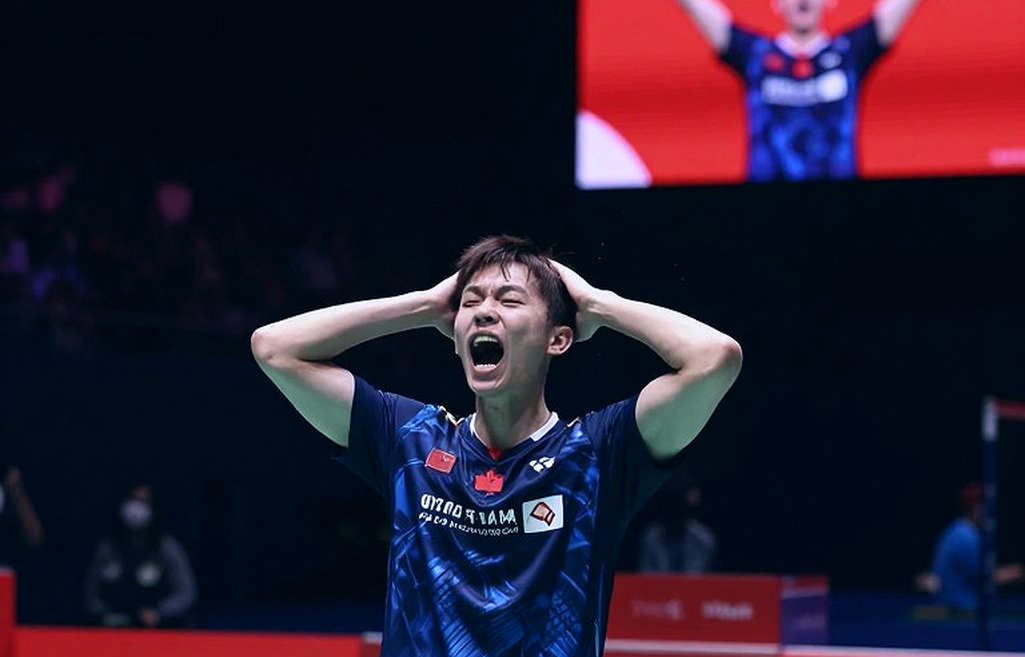
But the third game tells a different story. Not a technical one. Technique does not vanish after a fifteen-minute break. The third game is about stamina and the ability to regenerate energy between games. When Thuy Linh entered game three with legs no longer bouncing as they had in game two, Chen Yu Fei immediately raised the tempo. She pushed the shuttle to both corners, forced cross-court running, and within the first seven minutes the point gap became destiny. 12-21 is not a lost game. It is a game in which the body surrendered before the mind could react.
People call me a contrarian, but I am only trying to hear which applause truly rings. And the applause that truly rings here is not for the second game. It is for an uncomfortable truth: third-game stamina cannot be built in a week, a month, or a season. It is the product of years of living with a physical program, a gym, a nutritionist, and dozens of grueling three-game matches against top-10 opponents every month.
Now Hai Dang. His two matches read like a two-pole chart. First, 21-6, 21-6 against Odilzhon Abdurakhmanov. A professional, almost boring match. He controlled the shuttle, avoided silly errors, and closed it quickly. That says his fundamentals are solid. A player with weak fundamentals cannot close a qualifier at 21-6, 21-6. Consistency in must-win matches is a sign of professionalism, not raw talent.
But the second match, 16-21, 14-21 against Kunlavut Vitidsarn, was a different lesson. Kunlavut is not a power smasher. He is a patient defender, a rally extender, a man who turns your mistakes into his points. Against that archetype, Hai Dang did what many do: he could not break the defensive structure. Sixteen points in one game is not a bad result. But fourteen in the next says the opponent found a way to lock him down, and he had no Plan B.
Here is where I want to go deeper, because it touches how Vietnamese badminton reads matches. There is one archetype Vietnam still lacks answers for: the counterattacking defender, the rally extender, the player who forces you to attack until you collapse. That opponent does not beat you with power. He beats you with patience. To beat him, you need two things: enough variation in attack, and lungs durable enough to last three tense games.
Both Thuy Linh and Hai Dang show the first at some level. The 24-22 second game is proof. Hai Dang's control in the first match is proof. The second — the lungs, the stamina, the ability to maintain intensity in game three — is not there yet. That is my bet: Vietnam's real problem in continental singles is not stroke technique. It is physical conditioning and the conditioning system.
I do not write to reconcile. I write to dig up the corners people rush to cover with soil. The corner here is what every result report skips: there is no information about whether Thuy Linh and Hai Dang had a dedicated physical coach, a recovery plan, or a hitting group in the preparation week. When a player enters game three with dead legs, the cause is rarely that match. It is three weeks earlier, six months earlier, years of nobody pushing them to run until empty, then run once more.
This is my contrarian section. Vietnamese fans often say we lose because West Asian opponents are too strong, that Chen Yu Fei is world No.4, that Kunlavut is elite. True. But not enough. If it were pure class gap, Thuy Linh would have lost 2-0 cleanly, not stolen a 24-22 game. Her game-two win proves the technical class gap is not so wide as to make defeat inevitable. What made defeat inevitable was a physical collapse in game three.
Where could I be wrong? I am wrong if Thuy Linh actually had an excellent physical program and game three was a one-off — a cramp, or a strain after the long second game. I am wrong if she was quietly managing an ankle issue. I am wrong if she had played four matches in four days and game three was simply schedule fatigue rather than a system failure.
I could also be wrong by underrating mental factors. Some argue game three is a story of the head, not the legs — that if a player does not believe she can win, the body folds. That school has a point. But I keep my bet, because for an elite player, body and mind are not separable. When you have no legs, you also lose the confidence to hold tempo. Both collapse together, and it is hard to say which goes first.
For Hai Dang, my bet is similar but differs in shade. He lost 0-2, meaning he did not lose through a third-game fade. He lost because he could not break his opponent's defensive structure from the start. For him, the issue may be tactical rather than physical — specifically, a missing Plan B when an opponent shifts to a patient, defensive mode. That distinction matters.
There is a paradox in Vietnamese men's singles. We produce players with solid fundamentals, good shuttle control, capable of comfortably beating lower-ranked opponents. But against elite players who defend proactively and turn every attack into a counter, we often stall. Not because we are weak. Because we have never been placed in that situation often enough to build a reflex.
This is why I say the system matters more than individual talent. A player like Kunlavut is not born from nothing. He is born from a system where he plays dozens of matches against same-level opponents each year, where he loses and learns from those losses before reaching a continental stage. A Vietnamese player, by contrast, may face a top-20 opponent only a few times a year. That accumulated gap cannot be closed by a two-week camp.
So where are we on the continental map? In women's singles, Chen Yu Fei is the benchmark tier. Thuy Linh is the national No.1, capable of moments, but not yet in the same consistency tier. She sits in the chasing pack — able to trouble the top tier for a game, not yet able to convert it into a match win. In men's singles, Kunlavut represents elite Asian level. Hai Dang sits below that tier, with a clear gap shown by two consecutive scores.
But let me read the context more fairly. Both players reached the third round of a continental event. That is no small achievement. It proves the baseline of Vietnamese singles can clear early rounds against weaker opponents. The problem lies in the round where they meet elite opposition. And to pass that round, you do not need new technique. You need a body and a system durable enough to hold.
I once witnessed the empty-stadium matches of 2026, and the lesson was this: a match is not only the story of the person on court. It is the story of an entire system behind them — coaches, conditioning staff, video analysts, people handling meals and sleep. When we look only at the score, we see the tip of the iceberg. The submerged part is the entire infrastructure that produced the player.
The practical test for this conclusion is simple. If Vietnamese singles truly had a strong physical and analytical system, we would see a repeating pattern: Vietnamese players winning tense third games against equal or higher opponents. If we see the opposite — losing third games, or losing second games inexplicably — that is a signal of a system problem.
Here is my verifiable prediction for the next six to twelve months. First, if Thuy Linh meets another top-10 opponent and the match reaches a third game, I predict she will again struggle in the back half of the decider — unless there is a clear change in her physical program or match load. Second, if Hai Dang meets another counterattacking defender near the top 30, I predict he will need at least one game to find the answer rather than solving it from the start. Third, if Vietnam does not improve its doubles and team results, I predict we will keep depending on singles for every medal hope — a high-risk dependence.
I could be wrong on all three. But if I am right even partly, the lesson is not about Thuy Linh or Hai Dang. It is that we need to build a system where winning a third game is no longer a heroic story but a normal one. When that normal arrives, a 24-22 second game will no longer be the peak of the story. It will only be the starting point.
Before closing, I want to speak about Hai Dang once more, because I think he is being misread. His 21-6, 21-6 win over Odilzhon Abdurakhmanov is a match many will forget. I will not. It is proof he knows how to finish a match when expected to win. In elite sport, closing a match you are favored in is not easy. Many better players have lost such matches out of complacency.
Now picture the whole canvas. A continental Games with two Vietnamese players reaching the third round of singles. One took a game from the world No.4 before fading in the decider. One comfortably won an outer round before being locked down by an elite player. It is not a bad picture, but it is not one to over-celebrate. It is the picture of a badminton nation standing exactly at its boundary.
One thing I want readers to remember: badminton is not only smashes and beautiful rallies. It is a sport of systems. A national No.1 can take a game from the world No.4, but to win the match she needs a system strong enough to keep her standing through the final fifteen minutes. And those final fifteen minutes are something we need to start measuring, tracking, and investing in — right now.
Finally, let me return to my own story. Years ago, I was the girl mocked as someone who "knows nothing about football" at sixteen. I did not delete those comments. I kept them, reread them, and turned them into fuel to dig deeper into data. Today, when Thuy Linh loses a third game 12-21, I do not want to write a piece praising her to please readers. I want to write one showing what she needs next. That is what this job taught me: telling an uncomfortable truth is not a lack of love. It is the most serious way to love.
My ending is not a summary. It is a question I leave for myself and for readers. Twelve months from now, when Thuy Linh again enters a third game against a top-10 opponent, will she have the legs to reach the final point? The answer will not be on the court. It will be in the gym, in the video room, and in the meals nobody sees.
Cầu thủ liên quan
Bài đề xuất
19 Fateful Minutes: Satwik-Chirag and the Shock of Losing Themselves at Asian Games 20262026-09-26
The Shenzhen Memorandum: Srikanth, Satwik-Chirag, and the Data Problem of an Indian Badminton Generation2026-09-04
Loh Kean Yew's 10-Point Run: Where the Badminton Stat Sheet Stops2026-09-27
Tanvi Patri and the 2026 Asian U17 Title: Reading India's Women's Badminton Win Through the 15-Point Format2026-09-14
When a match analysis contains nothing but N/A: Should a sports journalist publish?2026-09-07
A Pioneer, But Still a Lonely One: Mahoor Shahzad's 23 Minutes at the Asian Games and the Vast Void Behind Pakistan Women's Badminton2026-09-27
Bài đề xuất
Tanvi Patri wins Badminton Asia U17 2026: decider composure and the limits of a junior title2026-09-14
Asian Games 2026: India, 20 Shuttlers and a Three-and-a-Half-Month Gap2026-09-11
India beat Bangladesh 3-0 at the Asian Games 2026: three scorelines and one squad structure2026-09-22
Vietnamese Badminton: Accumulated Fractures and the Recovery Equation After Paris 20262026-09-10
Thuy Linh at the Asiad: The Medal Problem and the Submerged Side of Vietnamese Badminton2026-09-15
Three Singles Generations and the Nine-Minute Trap: India Reach the Asian Games 2026 Quarter-Finals2026-09-22
Bài đề xuất
India beat Bangladesh 3-0 at the Asian Games 2026: three scorelines and one squad structure2026-09-22
Tanvi Patri and the 13 Games in Chengdu: Where the Real Signal Hides in the U17 Asia Crown2026-09-14
ASIAD 2026: India men topple Japan 3-0, women fall 1-3 – Behind the historic win lies the depth problem2026-09-23
PV Sindhu at the 2026 Asian Games: Reading the Campaign Through Data, Not Emotion2026-09-20
Satwik-Chirag Reach China Masters 2026 Semifinals: What Does the Win Over Astrup/Rasmussen Reveal About Their Asian Games Ambitions?2026-09-05
China Masters 2026: Indians Rewriting Their Own Narrative at the Quarter-Finals2026-09-04
Bài đề xuất
Reading the V-League Transfer Window Through Three Hidden Layers Behind a Contract2026-09-18
Satwik-Chirag Reach China Masters 2026 Semifinals, Srikanth Exits in Quarterfinals2026-09-05
122 Seconds in Aichi-Nagoya: How PV Sindhu Lost Her Semi-Final Ticket to Chen Yufei2026-09-28
India's Badminton Contingent at Asian Games 2026: When Collective Memory Blinds Us to the Truth About Power2026-09-16
Asian Games 2026: The Badminton Draw, First-Round Byes, and Two Unverified Pairings2026-09-25
China Masters 2026: Srikanth Returns to a Quarter-Final After Five Years, Satwik-Chirag and the Rhythm Problem2026-09-13